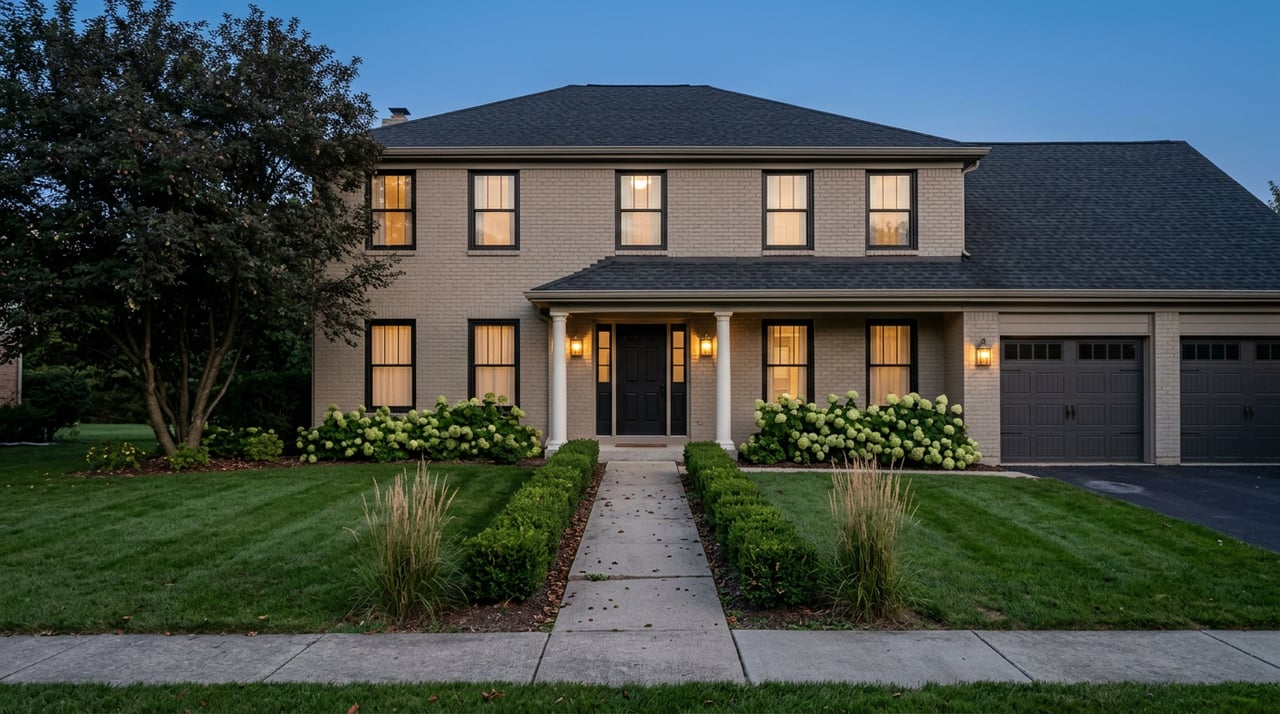
Why Two Naperville Homes at the Same Price Tag Can Carry Different Tax Bills
September 3, 2026
September 3, 2026
Walk the same $600,000 budget through two Naperville neighborhoods ten minutes apart and you can end up with two different ownership costs before you ever touch a paint color. Same city. Same school reputation on paper. Same MLS search radius. Different annual tax bill, sometimes by thousands of dollars.
The reason has nothing to do with the house. It has to do with an invisible line running through the middle of the city that most buyers never think to ask about until they're staring at a closing statement.
Naperville is not contained in one county. Most of the city sits in DuPage County, but the southern and eastern edges extend into Will County, and the two sides are assessed, billed, and appealed through entirely separate systems. The city also crosses six townships: Naperville and Lisle townships handle most of the DuPage side, while Wheatland and DuPage townships cover the bulk of the Will County side, with small slivers reaching into Winfield and Milton townships as well. If you've ever wondered why a neighbor two streets over files a tax appeal with a different office than you do, this is why.
None of that shows up on a listing photo. It shows up on the tax bill, and it's worth understanding before you fall for a house.
Here is where the gap becomes real money. Based on effective property tax rates compiled from local property records as of August 2026:
| DuPage County side | Will County side | |
|---|---|---|
| Effective tax rate | 2.05% | 2.35% |
| Median annual tax bill | $9,065 | $12,734 |
| Median home value | $443,310 | $544,293 |
The two medians aren't measuring identical homes, so you can't just subtract one bill from the other and call it a day. But you can apply the rate spread to a common price point. Take a typical $600,000 Naperville purchase: at 2.05%, you're looking at roughly $12,300 a year in property tax. At 2.35%, that same $600,000 home runs closer to $14,100. That's close to $1,800 a year, or $150 a month, that has nothing to do with square footage, finishes, or lot size. It's purely a function of which side of an unmarked line the parcel sits on.
And the DuPage side isn't even internally uniform. Effective rates there range from 2.35% in the 60564 zip code down to 2.01% in 60563, according to property tax data tracked by Ownwell. A single citywide average tax rate, the kind you'll see quoted on a national home value tool, describes no actual Naperville parcel. It's a blend of numbers that don't apply to any specific address, which is exactly why it's worth pulling the real figure for a specific parcel before you build a monthly payment around it.
The county boundary tends to correlate with other lines buyers are already tracking, which is part of why it gets overlooked. Naperville Community Unit School District 203, which includes Naperville Central High School, generally serves the older, more established sections of the city, which lean toward the DuPage County side. Indian Prairie School District 204, home to Neuqua Valley and Waubonsie Valley, generally serves the newer subdivisions to the south, which lean toward the Will County side.
That's a pattern, not a rule. School boundaries are drawn address by address and do not track county lines cleanly. A home on one side of a street can feed a different high school than the home directly across from it, and a home can sit in Will County while still zoning into a District 203 school. If a specific attendance area matters to your decision, verify it against the district's own boundary tool for that exact address rather than assuming it from the county or the zip code.
The same logic applies to commuter geography. Naperville has two Metra stations: the BNSF line downtown and the Union Pacific West line near Route 59, closer to the 60563 and 60564 zip codes. Walkability to either station tends to carry its own premium, layered on top of whatever the county and school lines are already doing to price. A buyer comparing two "Naperville" listings at the same number isn't comparing one product twice. They're comparing several stacked variables that happen to share a mailing address.
Timing works in a buyer's favor right now if the goal is to compare both sides of the county line against real listings rather than assumptions. Inventory in this market doesn't follow the calendar most buyers expect. New listings tend to bottom out in December and build from there, but active inventory, the actual number of homes a buyer can walk through at any given moment, peaks in September and October rather than in spring. Median days on market runs longest in January, at roughly 52 days, and shortest in May and June, at around 26 days.
Late August into early fall sits right at that inventory peak. For a buyer who wants to walk a DuPage-side listing and a Will County-side listing in the same week and compare the real numbers side by side, this is a wider selection window than the "spring buying season" advice usually accounts for. The broader market has stayed competitive either way. Recent data puts the sale-to-list ratio above 100 percent for homes sold in the second quarter of 2026, with close to 45 percent of homes selling above list price in that window. Competitive does not mean uniform. A seller's market on paper still leaves room to be selective about which side of the line you're buying into.
A few things are worth confirming before a number on a listing sheet becomes a number in your monthly payment:
How do I find out which county my Naperville home or target listing sits in? Check the county name printed directly on the property tax bill, or search the address through the DuPage County or Will County property lookup tool. Near the border, don't assume from the zip code alone.
Does being on the Will County side hurt resale value? Not inherently. Buyers weigh tax cost alongside lot size, school assignment, and commute, and Will County subdivisions often offer newer construction and larger lots at comparable prices. It's a tradeoff to price into your decision, not a red flag by itself.
Do county lines and school district lines always line up? Generally, but not always. Boundaries are set address by address. Always confirm the specific attendance area for a specific address rather than assuming it from which county the parcel sits in.
The headline median price tells you what Naperville costs to buy. It doesn't tell you what it costs to keep. That number depends on a line most buyers never ask about, and it's exactly the kind of detail that separates a rough budget from an accurate one.
If you're weighing a Naperville purchase and want the real numbers run for a specific address, not a citywide average, the Kimberly Zahand Team can walk you through exactly what a property will cost to own, on either side of the line. Let's work together.
Stay up to date on the latest real estate trends.

How Does the Appraisal Process Actually Work for Aurora Sellers?

Discover How to Put Together a Winning Offer in Naperville's Competitive Market.
Comparing Character, Cost, and Convenience Across Geneva's Housing Options.
Get assistance in determining current property value, crafting a competitive offer, writing and negotiating a contract, and much more. Contact us today.